Germany
How Sign Language Enables Participation
By David Zajonz
Published September 23, 2026
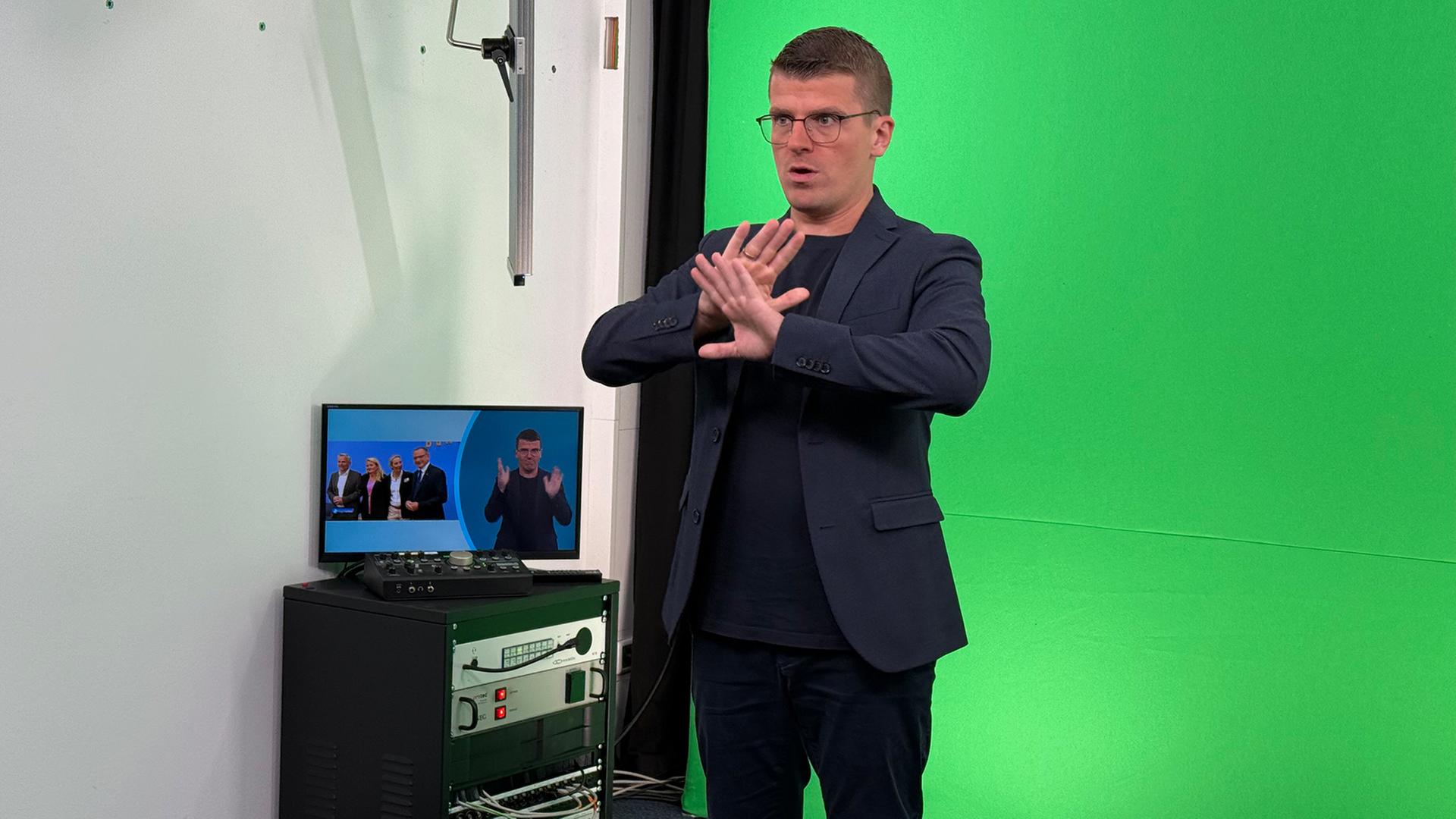
Sign language can enable participation for hard-of-hearing and deaf people. The tagesschau is thus interpreted by the television station Phoenix, and it is part of performances in an Essen sign choir.
Sign language can enable participation for hard-of-hearing and deaf people. The tagesschau is thus interpreted by the television station Phoenix, and it is part of performances in an Essen sign choir. A few minutes before the show, Marcel Zamojski still doesn't know what to expect from David Zajonz. He will soon be interpreting the 8 p.m. edition of the Tagesschau live in a Cologne TV studio.
“I know the rough topics and that's it,” says Zamojski. "Otherwise, I interpret by ear." He does not know the texts of the speakers and contributions beforehand. Zamojski is part of a team of sign language interpreters who simultaneously interpret the daytime show for the television station Phoenix. “I grew up with sign language,” he says.
His parents are deaf, he calls himself a native speaker. Nevertheless, the tagesschau with its many technical terms, place names and personal names is a challenge for him. There is no Duden for sign language. Zamojski uses various reference works in the preparation of shipments, for example, for the correct use of country names Sign language has its own grammar. However, sign language is constantly changing.
“Name signs or city signs evolve over time,” says Zamojski. Meanwhile, social media also plays an important role in finding common gestures for new terms. In case of doubt, Zamojski discusses with colleagues before the broadcast, for example, when it comes to finding a uniform gesture for the new national coach Jürgen Klopp. He can also spell unknown names using the finger alphabet.
Simultaneous interpretation is made more difficult by the fact that sign language follows a different grammatical logic than spoken language. For example, the verb is at the end of the sentence. “That means we wait until the sentence is over, and then we can shape our sentences,” says Zamojski. It is not known exactly how many people in Germany use sign language.
According to the German Deaf Association, there are about 80,000 deaf people nationwide. In addition, there are approximately 140,000 hard-of-hearing people whose disability is so severe that they are dependent on sign language interpreters. Choir sings and gestures at the same time The sign choir "TonZeichen" from Essen is also concerned with inclusion. She has always been passionate about music, says singer Christiane Terveen, who is hard of hearing from birth.
But there are not many offers for people like her: "Because it is always said: 'Oh, she is hard of hearing, there is nothing you can do with music anyway'," says Terveen. Now she is a member of a choir that sings and gestures at the same time. Last Sunday, the choir performed at an inclusive church service in Essen. Martina Meurer sat in the audience, she is chairwoman of the Protestant Deaf Association in Essen.
For deaf people, community is important, and inclusive worship creates a space for it. "If you do not notice anything, participation is not given" During the service, two pastors stood at the altar - one spoke, the other gestured. Choral singer Christiane Terveen would like to experience such events more often. Although hearing-impaired and deaf people could in principle participate in all public events, they were often left out.
"If you don't notice anything and don't hear anything, then participation is not given," says Terveen. This leads to social isolation: "It is easier to endure the loneliness in your own four walls than the loneliness in the group.“ She believes that more sign language offers could help against this form of loneliness.