Germany
Why the SPD is now hoping for Manuela Schwesig
By Anne-Katrin Mellmann, Moritz Rödle
Published September 17, 2026
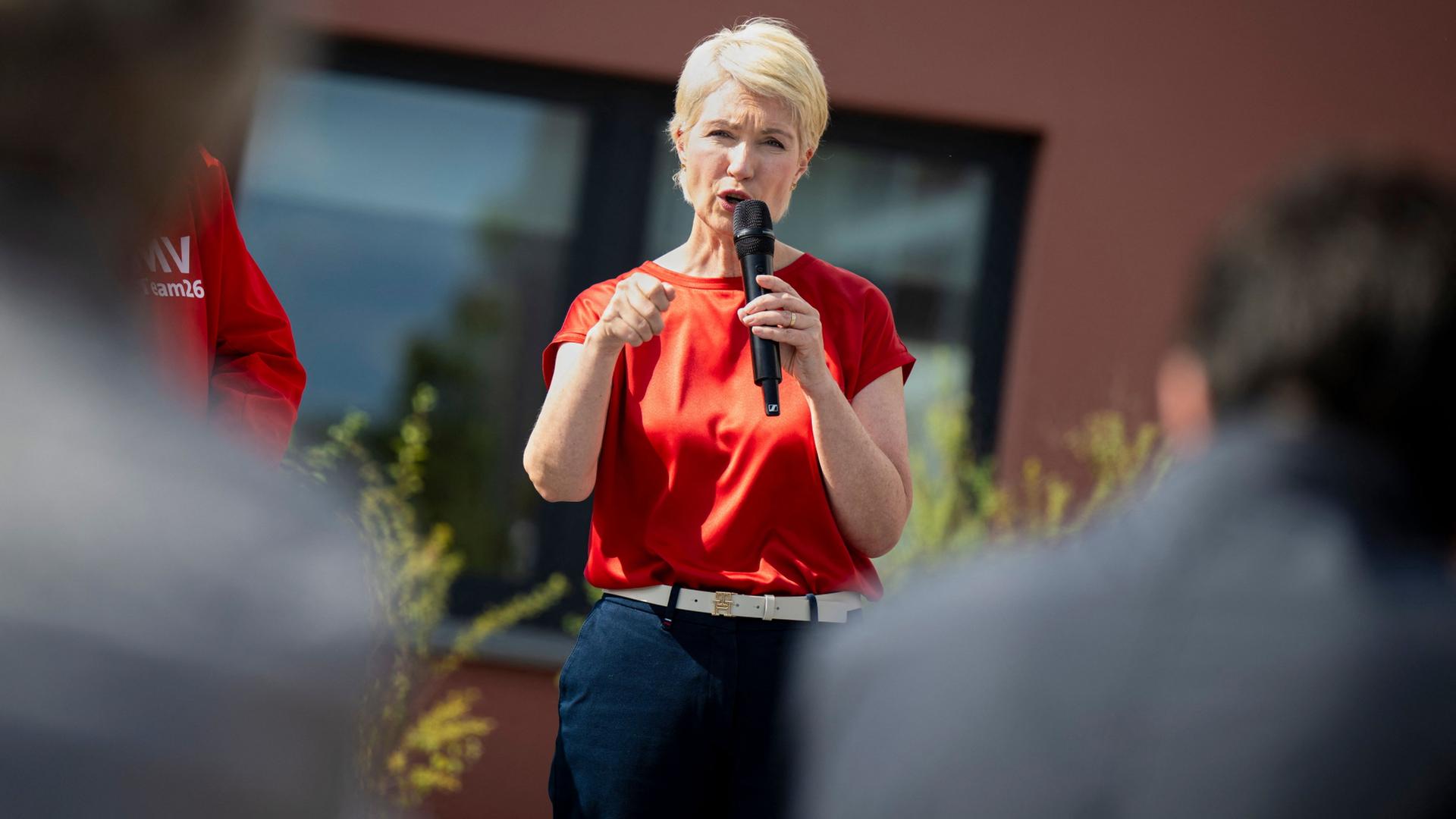
In the election in Mecklenburg-Western Pomerania, the SPD hopes for the traction of Prime Minister Schwesig. A success could stabilise the party somewhat, but the mood remains tense. By Anne-Katrin Mellmann and Moritz Rödle.
In the election in Mecklenburg-Western Pomerania, the SPD hopes for the traction of Prime Minister Schwesig. A success could stabilise the party somewhat, but the mood remains tense. By Anne-Katrin Mellmann, Moritz Rödle For the Federal SPD, it is clear that the party urgently needs a real sense of achievement. Since the SPD politician Steffen Krach will hardly be able to win the post of Governing Mayor in Berlin, much depends on the incumbent Prime Minister Manuela Schwesig in Mecklenburg-Western Pomerania for the SPD.
The party is currently catching up with the AfD, so there could be something to celebrate with the Social Democrats on Sunday for a long time. The mood is still lousy and there are many reasons for this. Race in Mecklenburg-Vorpommern seems to be open The Prime Minister of Mecklenburg-Vorpommern is conducting an election campaign that the SPD has not seen in a long time. She positions herself as the "woman against blue" - so her slogan - wants to overtake the AfD.
In surveys, this is still just ahead of the SPD, but the race seems to be open. "If you want me to stay, you have to go to the polls and vote for the SPD," says Schwesig confidently. It is the SPD's driving force. She does a lot of things better than other SPD leaders.
For example, her social media presence: there she shows herself in a hoodie at the barbecue or with older ladies on the park bench. And it's not just a show. Schwesig tours the villages during the election campaign. "I think the SPD is well advised when it is on site, when it knows the everyday topics and people need to feel that their everyday lives are improving." In the election campaign, Schwesig distinguishes himself from reform proposals from Berlin.
For example, about abolishing the deduction-free pension after 45 contribution years: "I know the situation of the people here and know that many have worked and paid for 45 years and much longer and still receive only small pensions. That's why I don't think it's right for such proposals to come up with a pension cut." In Berlin, Krach was beaten off in surveys. Her colleague Steffen Krach, the SPD's top candidate in Berlin, is similarly critical of pension reform. Krach is also up for election on Sunday, wanting to become Governing Mayor: "I say very concretely if I think things are going wrong. For example, if the federal level says we want to cut 1.5 billion in housing benefits, I think that's wrong." But Krach can't keep up with party colleague Schwesig, is far behind in surveys.
In addition, investigations into corruption allegations are incriminating him. Thus, the clear demarcation from the reform policy of the Federal Government remains his only commonality with Schwesig. Dissatisfaction with federal policy is great An obvious strategy, says political scientist Uwe Jun - especially for Schwesig - because dissatisfaction with federal policy is great in the eastern German states: "We have also seen this in Saxony-Anhalt. But there was no such popular top personality who could compensate for that.
Individual Prime Ministers manage to compensate for this dissatisfaction and strongly personalise an election. If they succeed, they can disconnect from the federal party." Krach and Schwesig say what they keep hearing from voters during the election campaign. People reflect their dissatisfaction. The dilemma of the SPD For the SPD at the federal level, this is a problem, because in the coalition with the CDU and CSU, the party must make painful compromises for them and the voters.
So far, the party leadership has not found a solution to this dilemma. On the contrary, the party came under even more pressure after the state election in Saxony-Anhalt. So it seemed like the flight forward, when the SPD leadership immediately announced that they wanted to talk again about the reform course taken with the Union: "No social reforms against the people," said Labour Minister Bärbel Bas. In addition, the SPD must cope with the CDU/CSU coalition partner weakened by the Saxony-Anhalt result and endure its attacks.
For example, the head of the Mittelstand parliamentary district Christian von Stetten called for the resignation of Bärbel Bas. Within the SPD, however, this has led to more support for the Minister of Labour. In addition, the economic and financial policy differences between the SPD and the CDU/CSU are again clearly evident in the fuel price debate. Both sides exchange the same arguments but find no common denominator.
The will remains to prove the ability to act even before the state elections on Sunday. "Nobody wants to go down on a ship" There are also internal personnel discussions in the SPD, which could pick up speed after the elections in Berlin and Mecklenburg-Vorpommern. Political scientist Wolfgang Schroeder says that there has been rumour in the SPD for a long time because of the dual offices of the two party leaders Bärbel Bas and Lars Klingbeil, who both head ministries at the same time. However, Schroeder does not see any alternatives "pushing forward".
With a view to the ailing coalition partner CDU/CSU, the SPD will first play for time and keep its feet still. The political scientist attests to personnel problems at the top of both camps: "They are bigger than ever before in the history of the Federal Republic. We have a real elite problem at the level of party leadership. And this in the most difficult situation of German development.
Party leaders with whom not only the public is dissatisfied, but also their own people. And at the same time, no one who really aspires to this office and is trusted to fill it better than those who currently hold it. Nobody wants to get on a sinking ship. But the Union must act because for it the problem is the biggest." If the SPD wins the election in Mecklenburg-Western Pomerania, the two chairmen Klingbeil and Bas should initially stabilise.
Major upheavals are not to be expected on Monday. An earlier version of this article referred to Wolfgang Schroeder as an SPD member. At his suggestion, we have changed this passage.