Germany
Homeland Security Division Exercise: Voltage drop at the motorway bridge
By Philipp Jahn
Published September 30, 2026
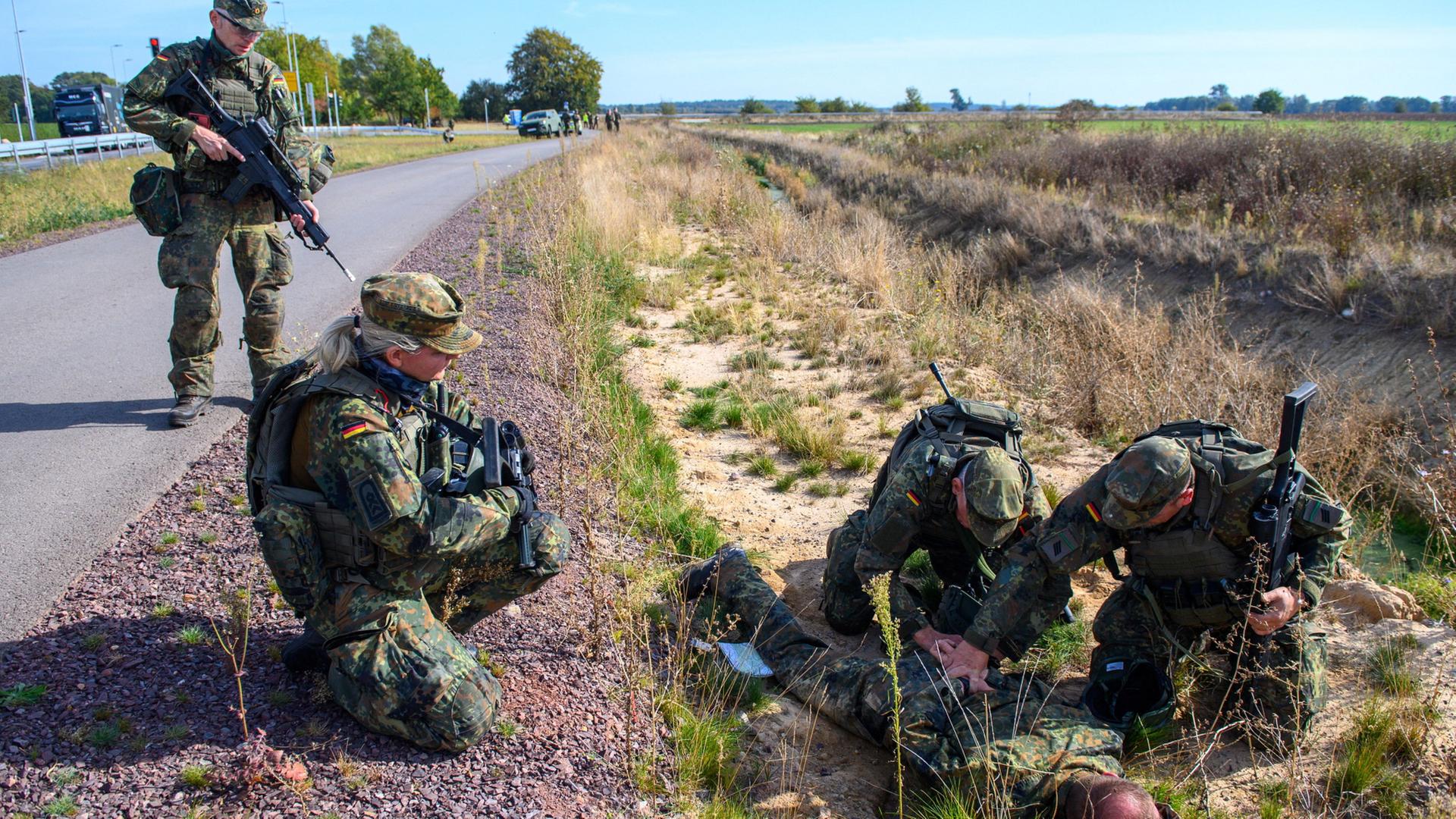
Last year, the Bundeswehr's Homeland Security Division was founded. Its tasks include the protection of critical infrastructure and drone defense. Now the first big exercise was going on in the public space.
Last year, the Bundeswehr's Homeland Security Division was founded. Its tasks include the protection of critical infrastructure and drone defense. Now the first big exercise was going on in the public space. By Philipp Jahn It is an unusual picture on a German street: heavily armed soldiers in combat gear, positioned behind sandbag barriers at intersections and city entrances.
In addition, there is a hill on which a position with a powerful grenade machine gun is built. Easily visible from the cars that travel between Stendal and the district of Insel. "This is not at all commonplace," says corporal Benny P., one of the reservists of the Homeland Security Division, who practice here in northern Saxony-Anhalt for three days. “People look at us a little funny." For the first time, the Homeland Security Division is practicing in public spaces - not hidden in barracks and on military training grounds, but in the middle of people's everyday lives.
The order of the reservists: protect the nearby bridge of the A14, prevent spying attempts and sabotage. Defence-important infrastructure "In our view, this is a main corridor for marching movements over which NATO forces are marching," explains Major Tom T., who worked out the exercise. Soldiers from other units act as opponents and try to spy out the bridge and positions. In reality, the bridge at the end of the motorway is far away from military routes, but in the scenario it is an important traffic junction on the way from Western Europe to the Baltic States.
The exercise takes place in peace, but the Bundestag has established the state of tension, the preliminary stage of the defensive case. This means that special laws apply, which also entail special powers for the Bundeswehr at home. Defence-important infrastructure such as this motorway bridge would be countless in the event of tension or defence. The exact locations are secret.
Homeland Security Division to grow The Homeland Security Division has only been around for a year and a half. At the moment, it consists of around 5,000 soldiers. Only 500 of them are active, all others are reservists. This means that they have civilian occupations and strengthen the Bundeswehr for a certain period of time, often several weeks a year.
"Protecting Germany in Germany", that is the task of the homeland protectors. This includes securing critical infrastructure as well as supporting its own and allied forces during transport through Germany, as well as drone defense and disaster relief. For these tasks, the division is expected to grow significantly in the coming years - mainly with reservists. "I find Germany worthy of protection" Reservist Benny P.
works in civilian life as a specialist computer scientist in a local administration in Schleswig-Holstein. When Russia invaded Ukraine in February 2022, he asked himself the question: "What if it were here with us, what would I personally do?" His path then was to join the armed forces. "Because I think Germany is worth protecting," says the 31-year-old. "Homeland security is a good way to get involved," says his comrade Christian S., actually an office worker in a mechanical engineering company.
The exercise makes the threat situation even more aware, says the 46-year-old corporal. “We'd all be happy if it wasn't so. In the end, soldiers would always be the first to come into danger." Abolition of "double volunteering" By 2033, the Bundeswehr reserve is to grow to 200,000 reservists. In order to achieve this, the Federal Government passed the Reserve Strengthening Act at the beginning of July.
In October, it should go to the Bundestag. The core of the law is the abolition of so-called double voluntariness. So far, both the reservists themselves and their employer had to agree so that they could be used for exercises or other services. The law should now allow for a mandatory use.
Criticism of this comes from industry. The German Chamber of Industry and Commerce (DIHK) warns of shortages of skilled workers. "The Bundeswehr should announce deployments at least three months before the reserve service," demands DIHK department head Rainer Kambeck. The desire is more predictability for employers.
Exercise should create border experiences There is no planning around the motorway bridge south of Stendal. The homeland defenders don't know what to expect. Suddenly, a drone sighting triggers an alarm, and a suspicious vehicle is on a dirt road. A small group of reservists rush to the vehicle and apprehend the four drone pilots.
One of them fights back and pulls out a gun, shots are fired. Major T. and his team observe the action of the reservists. After the exercise, he evaluates the events with them: What happened?
What went well? What could go better? The aim of the exercise is to create border experiences so that the reservists are prepared in an emergency. And: "We as the Bundeswehr should also be more present again," says the 36-year-old.
“We're just citizens in uniform. And I think it's also a good chance to show that we're doing a good job."