Germany
Is the CDU about to end as a people's party?
By Jasper Ruppert
Published September 24, 2026
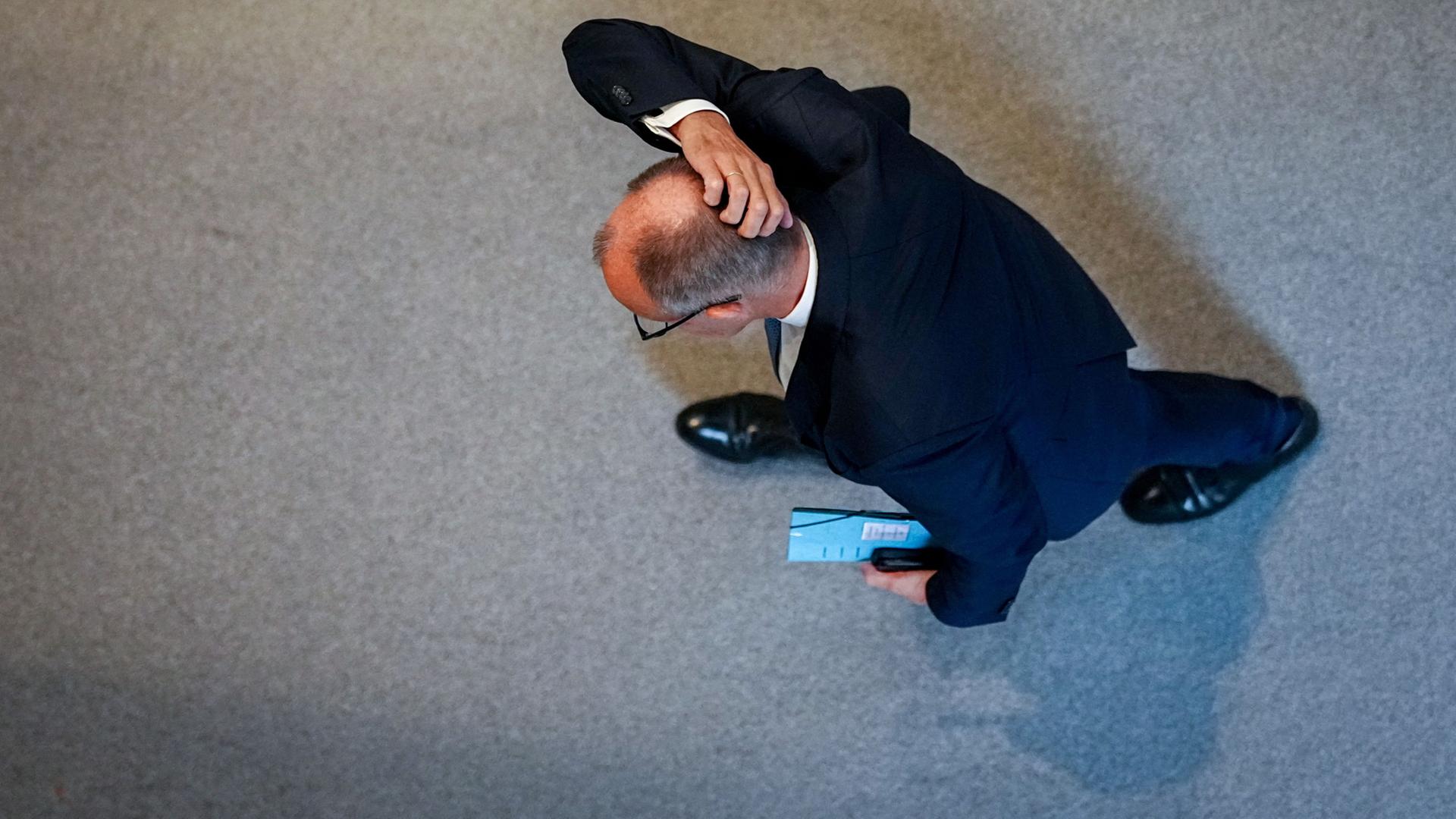
Friedrich Merz was asked after the election disaster whether the CDU was still a people's party: "Only in parts," the chancellor replied. What does this mean in concrete terms? And is the AfD now a people's party?
Friedrich Merz was asked after the election disaster whether the CDU was still a people's party: "Only in parts," the chancellor replied. What does this mean in concrete terms? And is the AfD now a people's party? Jasper Ruppert Friedrich Merz has a definition ready on the fly: "A people's party is a people's party if it reaches all groups of a society." And he adds that this applies to his party "only in part".
Merz lists groups: employees, companies, socially engaged people, families - a party is a people's party "if it has a sounding board there, if it is seen there as a political force capable of absorbing and solving the concerns of the people, the problems of the population". They want to get back there, "we will fight for this goal," says Merz. The CDU only "in parts" a people's party? According to Alice Weidel, she's not even that anymore.
After the AfD victory in Mecklenburg-Western Pomerania, the co-leader of the party declared: "This clearly shows that we have replaced the CDU as a people's party.“ What does it take to be a People's Party? Merz already mentioned an essential point in his answer: A People's Party does not make policy for a particular group or is centrally dedicated to a topic such as the Pirate Party or the Animal Welfare Party. "It is characterized by a breadth of programmatic offerings," explains political scientist Aiko Wagner from Freie Universität Berlin. In the ARD interview, Wagner mentions further criteria: "The sheer size in voting shares, in seats in the parliaments." It also included duration, party consistency and government participation.
"All this should already be in place so that one can speak of a people's party," says Wagner. In addition, there would be the bundling of interests, a social rootedness through, for example, local associations, as well as the "pre-pacification of social conflicts," according to Wagner. At the same time, he points out that political science does not have such clear definitions as in other areas - and these are then also politically contested: "If the AfD claims to be a people's party, then it does not want to make an analytical contribution to political science, but to make a point in political competition." Can you be a people's party "in parts", as the Chancellor about the CDU? Wagner suspects that Merz meant it locally "that the CDU is still a people's party only in parts of Germany".
After all, the party has just missed entering the state parliament of Mecklenburg-Vorpommern. The criterion of size is therefore no longer given there. Wagner, on the other hand, believes that all other requirements continue to be met by the Union. AfD "well on its way" to the People's Party And the AfD, which now calls itself the People's Party?
"She has managed to penetrate more and more areas of society," says Wagner. She now has the size. What is missing, on the other hand, is: "It does not yet have this stable membership base, as other people's parties have." And another aspect does not exist: "It does not yet have long-term stable apron organisations - such as churches or trade unions - so that communication with society can only be directly mediated by the party and not mediated." Even with the programmatic breadth, Wagner does not yet see the AfD at the level of a People's Party. "It is a very pronounced far-right party and does not reach far into the middle." In addition, it has only been comparatively successful for a short time.
"Intermediate highs are not yet a sign that you are a people's party.“ But political scientist Wagner also says, 'She's on her way there. "Era of people's parties possibly over CSU leader Markus Söder said almost exactly two years ago that the Union was" perhaps the last remaining large, largest and only people's party ". A CDU chancellor is now questioning whether this is still true. But is it still possible for the people's parties to survive? "In many other major European democracies, there was a massive decline in popular parties that had already begun decades ago," explains Wagner from Freie Universität Berlin.
France is one such example in which Emmanuel Macron has pushed several established parties to the brink of insignificance with his "En Marche"movement. In addition to the Union in Germany, Wagner also mentions the Social Democrats in Spain and Labour in Great Britain, who have long been able to hold their own as popular parties. But times would have changed altogether. Our modern societies are much more heterogeneous, pluralistic and individual than before - Wagner sees this as the main reason why it is increasingly difficult to be a people's party.
"With changing social realities, party preferences also change in some cases, so that there is more dynamism." It has become more difficult to unite people under one 'big tent'. "In this respect, it is true that the era of the people's parties seems to be a bit over."