Germany
Berlin election - Kristin Brinker from the AfD: top candidate without government opportunities
By Jonas Wintermantel und Markus Reher, rbb
Published September 18, 2026
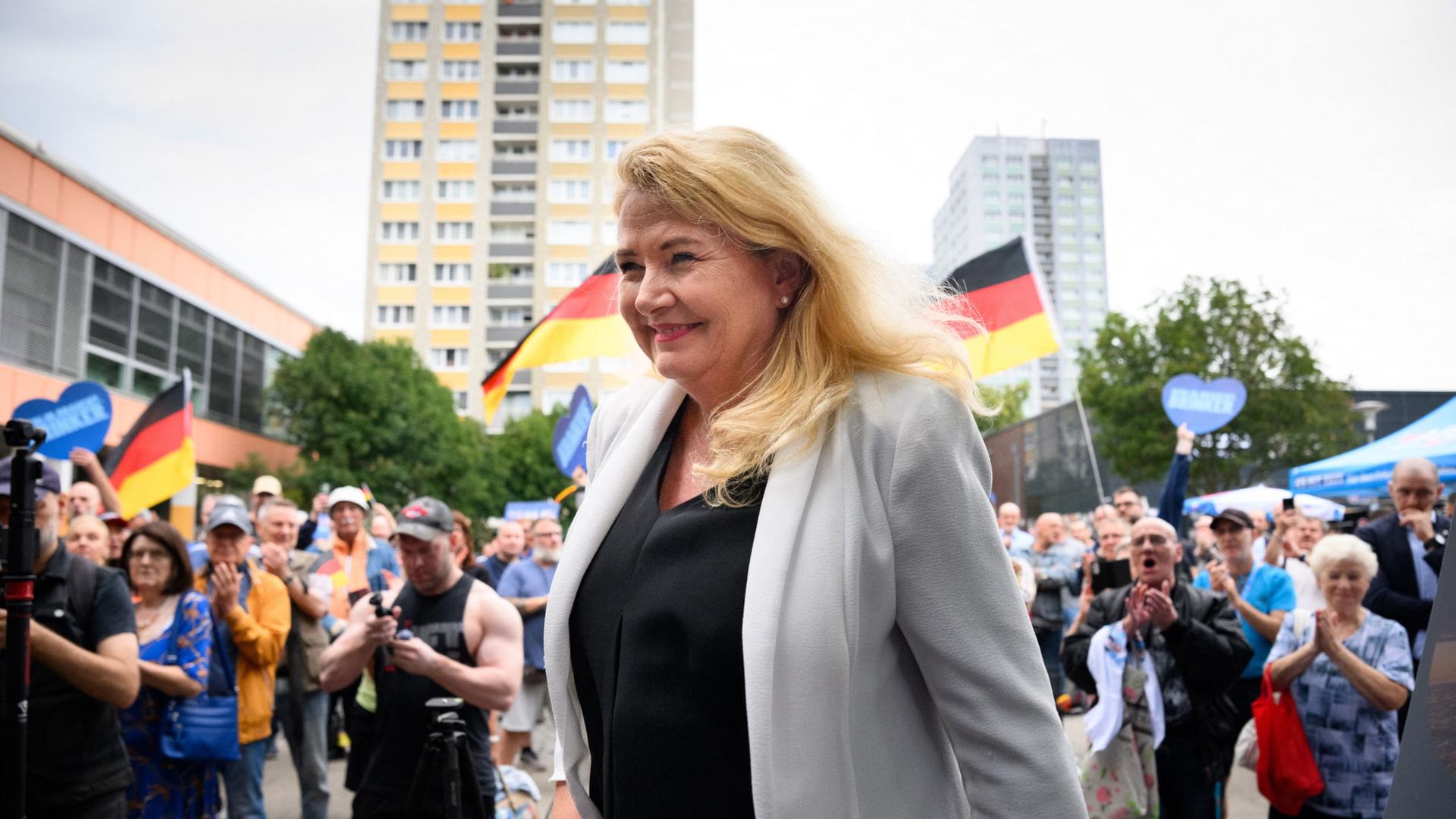
Kristin Brinker is running for the third time as the AfD's top candidate in Berlin. Your party can expect growth. But it does not have a government option; no one wants to coalition with it. By Jonas Wintermantel and Markus Reher.
Kristin Brinker is running for the third time as the AfD's top candidate in Berlin. Your party can expect growth. But it does not have a government option; no one wants to coalition with it. By Jonas Wintermantel and Markus Reher, rbb He can already be seen from afar in the pedestrian zone in Tegel: The blue umbrella with the big letters: AfD.
Kristin Brinker, the top candidate - blonde hair, pink top, dark blue jacket, the party newspaper "Blauer Bote" under her arm - is touting voter favour. Not so easy here in the north of Berlin. Tegel, known for its former airport and the picturesque lake, is located in the district of Reinickendorf - the AfD was only the fourth strongest force in the past election in 2023. The federal issues predominate "What actually repels me a bit is your proximity to Russia," says a passerby.
- "Alice often shows things that are not worthy of a person with her qualifications." - "He said that the AfD is generally against women's rights and against children's rights," a passerby is outraged by Höcke. - "Well, I don't know in what context he said that, and that's why it's always very difficult to respond to something like that, because I don't know the circumstances," Brinker replies. The 54-year-old often tries to get away from the federal issues: "Now we are here at the Berlin election, we have very different urgent issues, maybe we can still convince you." Many are asking about federal issues that we can't necessarily solve at the state level right now, "says Brinker. The national programme" plays a rather subordinate role.
And that, of course, makes it difficult when you're in the state election campaign." The Saxon-born hitchhiker has been in the House of Representatives since 2016, and has led the state association since 2021. Signs of normalization At the election stand in Tegel, however, there is also encouragement: "I'll cross my fingers for you, "an older woman shouts. "I very much hope that the AfD will come along now, because it will save our country, "says another. When asked what expectations it has of the AfD, it becomes more concrete, talking about pensioners "who have to dig in the garbage cans in order to earn a little extra bread".
And about her son, who has been looking for an apartment for a long time and can't find one. Sometimes a truck honks in passing, Brinker waves back cheerfully, sometimes a passerby calls out "thank you" to the election campaigners. Many of the sympathisers are annoyed with the way the other parties deal with the AfD. “Banning is not a solution,” says a passerby.
"Why are there so many who want to vote?" People are more open, says top candidate Brinker, "are also significantly less afraid to show that they sympathise.” In the meantime, she gives the willingness to talk: "I go to everyone." Apartments first for "locals" As the AfD imagines Berlin, this can be seen well in two topics: housing and traffic. The surveys show that there are two topics that move Berliners the most. The key demand when it comes to housing policy: state-owned apartments should preferably go to long-term Berliners. "Apartments are not asylum homes" is the title of the "Blaue Bote", the AfD newspaper for the capital, which Brinker is carrying with him during the election campaign.
In terms of traffic, the AfD is clearly focusing on the car - "motorised private transport" is "an indispensable part of urban mobility", according to the election programme. She herself is a "passionate motorist", Brinker reveals in an interview with the ARD lunchtime magazine. While driving through bustling Neukölln, the real estate manager explains her traffic solution for Berlin, which in some surveys is considered the traffic jam capital of the Republic. "Here you can see very nicely in this picture this typical Berlin block edge development and we think that it makes more sense to drive the main motorized traffic over the main road and the bicycle traffic here over these secondary roads".
Demands and rhetoric have become sharper While Kristin Brinker is emphatically moderate in the election campaign, the radical forces in the Berlin AfD have gained influence under her chairmanship. On the subject of migration and asylum, the election programme for 2021 still stated: "Enforce deportations and enable remigration." Today, the AfD is also calling for an "immediate stop to the reception of asylum seekers in Berlin", a moratorium on all naturalisation procedures and a "State Office for Immigration, Asylum and Remigration". Elsewhere, it is said that permanent security in Berlin "can only be achieved through a consistent remigration policy". Remigration: a buzzword of the extremist New Right.
"It's enough for me too" Kristin Brinker has not publicly used the term for a long time. In Tegel, she now defines it as "repatriation of people who do not have a residence permit, who have therefore gone through all legal channels - and of course also those who have become seriously criminals here." The programme only mentions one specific number: the "immediate deportation of all of the up to 20,000 persons obliged to leave Berlin". Brinker rejects the accusation that her party has moved to the right. “We just say what we want and what we think is right.
If all other parties form a popular front against us, then sooner or later what we are likely to experience in Saxony-Anhalt will happen - namely an (AfD)sole government." "Popular Front"" - another term that Brinker would not have mentioned a few years ago. “Maybe,” Brinker says. "But it's enough for me too." Heimspiel im Osten Ortswechsel - ein Tag später vor dem Linden-Center in Neu-Hohenschönhausen im Ostberliner Bezirk Lichtenberg. Here, the AfD came to 13.8 percent in the last House of Representatives election in 2023 - significantly above the overall election result in Berlin of 9.1 percent.
Brinker is greeted like a star, passers-by take photos and get autographs. A cluster of people forms in front of the stand. "They stand up for the citizens," says a passer-by, "and that is my main concern that we will not be forgotten." A young man in training mentions his expectations: "Cutting taxes, that's the first thing. Creating more living space.
I'm afraid of not finding an apartment." And here, too, a similar sentence falls on the AfD as the day before in Tegel: "Because they want to save Germany." " In 1989, no one believed that the wall would fall. " In order to implement the high expectations of their supporters, the Berlin AfD would need a government option. The other parties, which, according to the polls, can certainly expect to return to the House of Representatives (CDU, SPD, Greens and Left), however, rule out working with the AfD. Brinker calls the other's "firewall" a "protective wall for their own power options" and predicts: "They are failing!" Then, once again, she strives for a historical comparison: "In 1989, no one believed that the wall would fall." The party is far from an option for a single government. In the ARD pre-election survey, it came to 18 percent.